Kotor
Go in May–June or September–October for exploring Kotor with fewer summer crowds.

When is the best time to visit Kotor?
Go in May–June or September–October for warm weather and fewer crowds than in summer.
Month by month
- Ideal
- Good
- Workable
- Poor / Avoid
- Now
October · Good. Mild days, a still-warm sea and lower prices, despite frequent showers.
Pick a month to read its note
January
- High / low
- 13° / 5°
- Rain
- 11 days
- Sea
- 14°
- Daylight
- 9 h 30 min
- Crowds
- Low
- Prices
- Low
February
- High / low
- 14° / 5°
- Rain
- 10 days
- Sea
- 14°
- Daylight
- 10 h 36 min
- Crowds
- Low
- Prices
- Low
March
- High / low
- 16° / 7°
- Rain
- 10 days
- Sea
- 14°
- Daylight
- 12 h
- Crowds
- Low
- Prices
- Low
April
- High / low
- 19° / 10°
- Rain
- 10 days
- Sea
- 15°
- Daylight
- 13 h 24 min
- Crowds
- Shoulder
- Prices
- Shoulder
May
- High / low
- 24° / 14°
- Rain
- 9 days
- Sea
- 18°
- Daylight
- 14 h 36 min
- Crowds
- Shoulder
- Prices
- Shoulder
June
- High / low
- 28° / 18°
- Rain
- 6 days
- Sea
- 21°
- Daylight
- 15 h 12 min
- Crowds
- Shoulder
- Prices
- Shoulder
July
- High / low
- 31° / 20°
- Rain
- 4 days
- Sea
- 24°
- Daylight
- 14 h 54 min
- Crowds
- Peak
- Prices
- Peak
August
- High / low
- 32° / 21°
- Rain
- 4 days
- Sea
- 25°
- Daylight
- 13 h 54 min
- Crowds
- Peak
- Prices
- Peak
September
- High / low
- 27° / 17°
- Rain
- 7 days
- Sea
- 23°
- Daylight
- 12 h 30 min
- Crowds
- Shoulder
- Prices
- Shoulder
October
- High / low
- 23° / 13°
- Rain
- 9 days
- Sea
- 20°
- Daylight
- 11 h 6 min
- Crowds
- Shoulder
- Prices
- Low
November
- High / low
- 18° / 10°
- Rain
- 12 days
- Sea
- 17°
- Daylight
- 9 h 48 min
- Crowds
- Low
- Prices
- Low
December
- High / low
- 14° / 6°
- Rain
- 12 days
- Sea
- 15°
- Daylight
- 9 h 6 min
- Crowds
- Low
- Prices
- Low
Things to do in Kotor
Kotor is best for historic streets, the fortress walk and boat trips on the bay.
Climb the walls to St John's Fortress
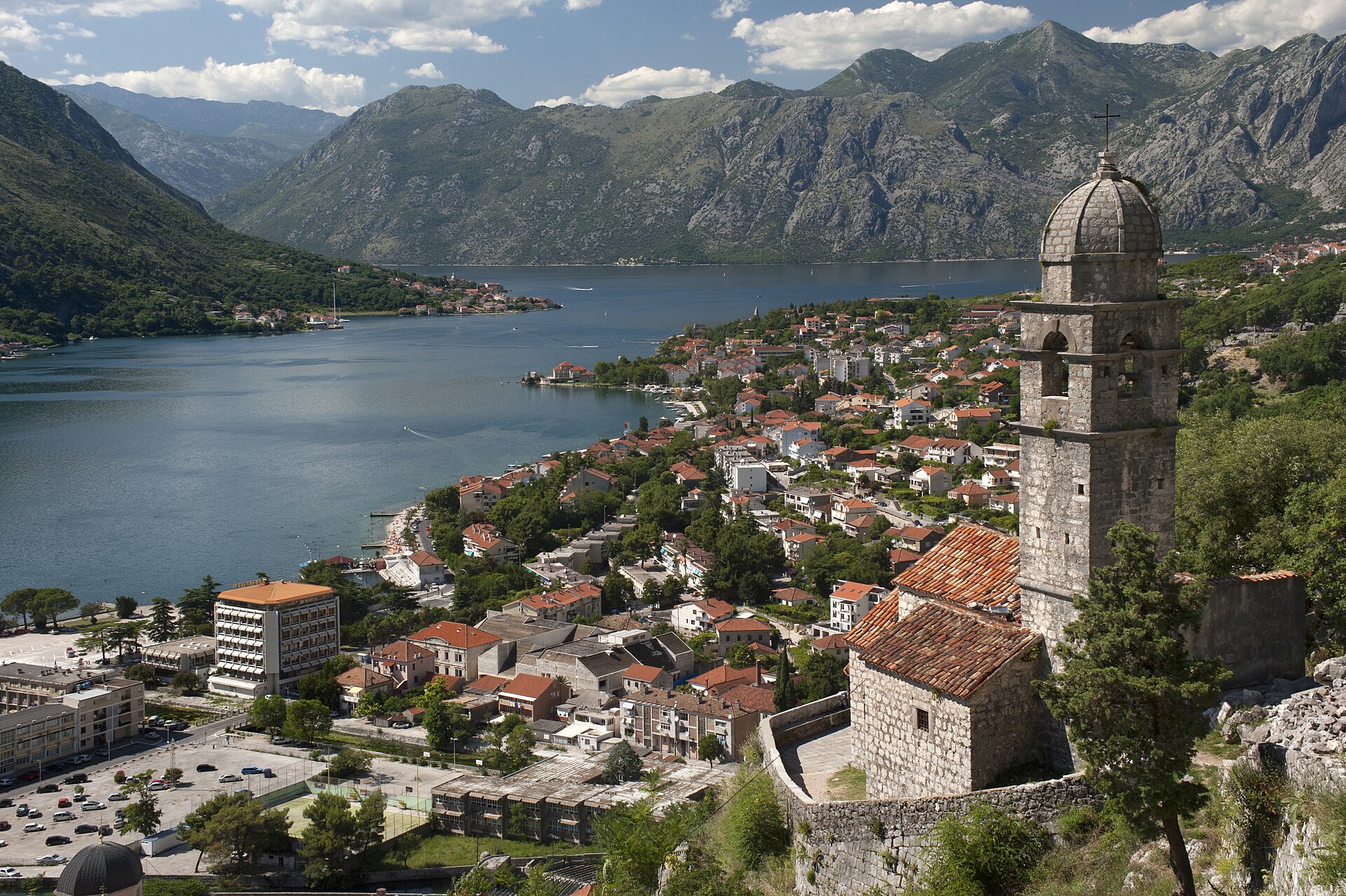
Follow the steep fortified path above the old town to the ruined fortress, looking back across the tiled roofs and inner bay. Allow time for the descent as well as the climb.
Explore the old town from the Sea Gate
Start at the Sea Gate and wander through the pedestrian lanes, linking the Square of Arms with smaller squares and palace façades. The gate provides a clear starting point for exploring the compact walled centre.
Examine the stonework in St Tryphon's Cathedral
Step inside the Romanesque cathedral to see its carved stone canopy, surviving fresco fragments and religious treasures. It offers a closer look at Kotor's craftsmanship than a circuit of the exterior alone.
Trace the bay's seafaring history
Explore the Maritime Museum inside the Grgurina Palace, with ship models, portraits and maritime paintings. The collections explain the seafaring families and naval traditions that helped shape the bay's towns.
Discover the marine life beneath the bay
Visit this small public aquarium associated with the University of Montenegro's Institute for Marine Biology. Its Adriatic species and conservation displays give context to the waters outside, making a useful contrast to the old town's historic buildings.
Take a beach break beside the bay
Head to the town beach for a swim in suitable conditions or a pause beside the water. This small pebbly stretch provides an easy outdoor break without leaving Kotor.
Where to stay in Kotor
Stay in or near the Old Town for sights and restaurants, or choose Dobrota for a waterside base.
Stay inside the walls for sightseeing on foot
Choose the Old Town for historic lanes, squares and restaurants on your doorstep; the trade-offs are night-time noise and carrying luggage from outside the pedestrianised walls.
More space along the bay
Dobrota suits travellers seeking waterfront apartments and a calmer base outside the walls. It stretches north along the bay, so check the property's actual location rather than assuming an easy walk into the Old Town.
Look back towards Kotor from the opposite shore
Muo suits a quieter, self-catering stay with views towards Kotor across the water. The compromise is less immediate access to the centre's restaurants: check the roadside walking route and transport options before booking.
How much does a trip to Kotor cost?
Budget ≈€100–170 a day mid-range, or €45–75 on a budget; summer accommodation can cost more.
Mid-range
€100–170
per person, a day
Budget
€45–75
per person, a day
Comfort
€150+
per person, a day
What things cost
- Espresso at Restoran Galerija.
- ≈€2
- Bakery snack, such as burek or a pastry. Daily budget bands are planning estimates for shared accommodation, meals, transport and sightseeing; summer accommodation can cost more.
- €2–4
- City walls and St John's Fortress: individual admission.
- ≈€15
- Combined admission to the Lapidarium, St Paul's Church and Solidarity Gallery.
- ≈€6
Getting to and around Kotor
Fly to Tivat, the nearest airport, or arrive via Podgorica or Dubrovnik; explore the Old Town on foot and take a boat trip on the bay.
Getting there
- By air
- Tivat Airport — nearest airport. (TIV), Dubrovnik Airport, Croatia — requires a land border crossing. (DBV), Podgorica Airport. (TGD)
Before you go: visas, safety and money
Check entry rules for your passport; Montenegro uses the euro, and you should watch for pickpockets at tourist sites and on public transport.
Do I need a visa for Kotor?
- EU and Schengen citizens
- EU citizens and citizens of Iceland, Liechtenstein, Norway and Switzerland can enter without a visa for up to 90 days with a valid passport. A valid national identity card allows a visa-free stay of up to 30 days.
- UK citizens
- British citizen passport holders can visit without a visa for up to 90 days in any 180-day period. Your passport must have been issued less than 10 years before arrival and remain valid for at least 3 months after your planned departure.
- US citizens
- US passport holders can visit without a visa for up to 90 days in any 180-day period. The US State Department states that your passport must be valid at entry, with one blank page available for an entry stamp.
- Other passports
- Visa requirements and permitted stays depend on nationality: Montenegro's official list grants many passport holders visa-free visits of up to 90 days, while others need a visa. A valid passport is required; confirm the applicable visa, stay limit and passport-validity requirements with a Montenegrin diplomatic mission before travel.
From 1 November 2026, nationals of Belarus, China, Russia, Saudi Arabia and Türkiye will require a visa to enter Montenegro, according to the Ministry of Foreign Affairs announcement.
Is Kotor safe?
As of 28 October 2026, the US rates Montenegro Level 1: exercise normal precautions; the UK FCDO advises against travel to no specific areas. Watch for pickpockets at tourist sites, beaches and on public transport, and avoid isolated areas at night and confrontations. Rural roads deteriorate in winter and bad weather; the Morača Canyon road can be dangerous in poor conditions, while summer congestion affects coastal routes. Wildfires are common April–October, earthquakes are possible, and mountain walkers should stay on marked paths and check local weather advice.
Quick facts
- Emergency
- 112 (all services), 122 (police), 123 (fire), 124 (ambulance).
- Money
- Euro (€); cards are widely accepted in hotels, restaurants and shops, but carry cash for smaller cafés, markets and taxis. Tipping is optional; around 10% is appreciated for good restaurant service, and rounding up is usual for taxis and bars.
- Plugs
- Type C and F, 230 V, 50 Hz.
Do I need a visa for Kotor?
- EU and Schengen citizens
- EU citizens and citizens of Iceland, Liechtenstein, Norway and Switzerland can enter without a visa for up to 90 days with a valid passport. A valid national identity card allows a visa-free stay of up to 30 days.
- UK citizens
- British citizen passport holders can visit without a visa for up to 90 days in any 180-day period. Your passport must have been issued less than 10 years before arrival and remain valid for at least 3 months after your planned departure.
- US citizens
- US passport holders can visit without a visa for up to 90 days in any 180-day period. The US State Department states that your passport must be valid at entry, with one blank page available for an entry stamp.
- Other passports
- Visa requirements and permitted stays depend on nationality: Montenegro's official list grants many passport holders visa-free visits of up to 90 days, while others need a visa. A valid passport is required; confirm the applicable visa, stay limit and passport-validity requirements with a Montenegrin diplomatic mission before travel.
From 1 November 2026, nationals of Belarus, China, Russia, Saudi Arabia and Türkiye will require a visa to enter Montenegro, according to the Ministry of Foreign Affairs announcement.
Is Kotor safe?
As of 28 October 2026, the US rates Montenegro Level 1: exercise normal precautions; the UK FCDO advises against travel to no specific areas. Watch for pickpockets at tourist sites, beaches and on public transport, and avoid isolated areas at night and confrontations. Rural roads deteriorate in winter and bad weather; the Morača Canyon road can be dangerous in poor conditions, while summer congestion affects coastal routes. Wildfires are common April–October, earthquakes are possible, and mountain walkers should stay on marked paths and check local weather advice.
Money, plugs and emergencies
- Emergency
- 112 (all services), 122 (police), 123 (fire), 124 (ambulance).
- Money
- Euro (€); cards are widely accepted in hotels, restaurants and shops, but carry cash for smaller cafés, markets and taxis. Tipping is optional; around 10% is appreciated for good restaurant service, and rounding up is usual for taxis and bars.
- Plugs
- Type C and F, 230 V, 50 Hz.
Questions people ask
Is Kotor worth visiting?
Yes, especially if you enjoy historic architecture and exploring on foot. The old town is compact, so a longer stay makes most sense if you also want to explore the bay or walk in the surrounding hills.
How many days do you need in Kotor?
Two or three days gives you time to see the old town and explore beyond it without rushing. Add more time if you want to use Kotor as a base for other places around the bay.
Do you need a car in Kotor?
No, you can explore the old town on foot and use boats or public transport for some trips around the bay. A car gives you more freedom for inland excursions, but parking near the old town can be difficult in summer.
Is Kotor expensive?
Kotor can be relatively expensive for Montenegro, particularly for accommodation in the summer. Eating away from the busiest squares and staying outside the old town can help keep costs down.
Is it better to stay in Kotor or Dobrota?
Stay in Kotor's old town for the easiest access to sights and restaurants, or choose Dobrota for a quieter waterside setting. Dobrota stretches along the bay, so check your accommodation's location if you want to walk into town.
Is Kotor a good place for a beach holiday?
Kotor is better suited to sightseeing and boat trips than a beach-focused holiday. There are places to swim around the bay, but travellers looking for broad sandy beaches may prefer another part of Montenegro's coast.
Which airport is best for Kotor?
Tivat is the nearest airport and is usually the simplest choice if a suitable flight is available. Podgorica and Dubrovnik are alternatives, though arriving from Dubrovnik involves a land border crossing.